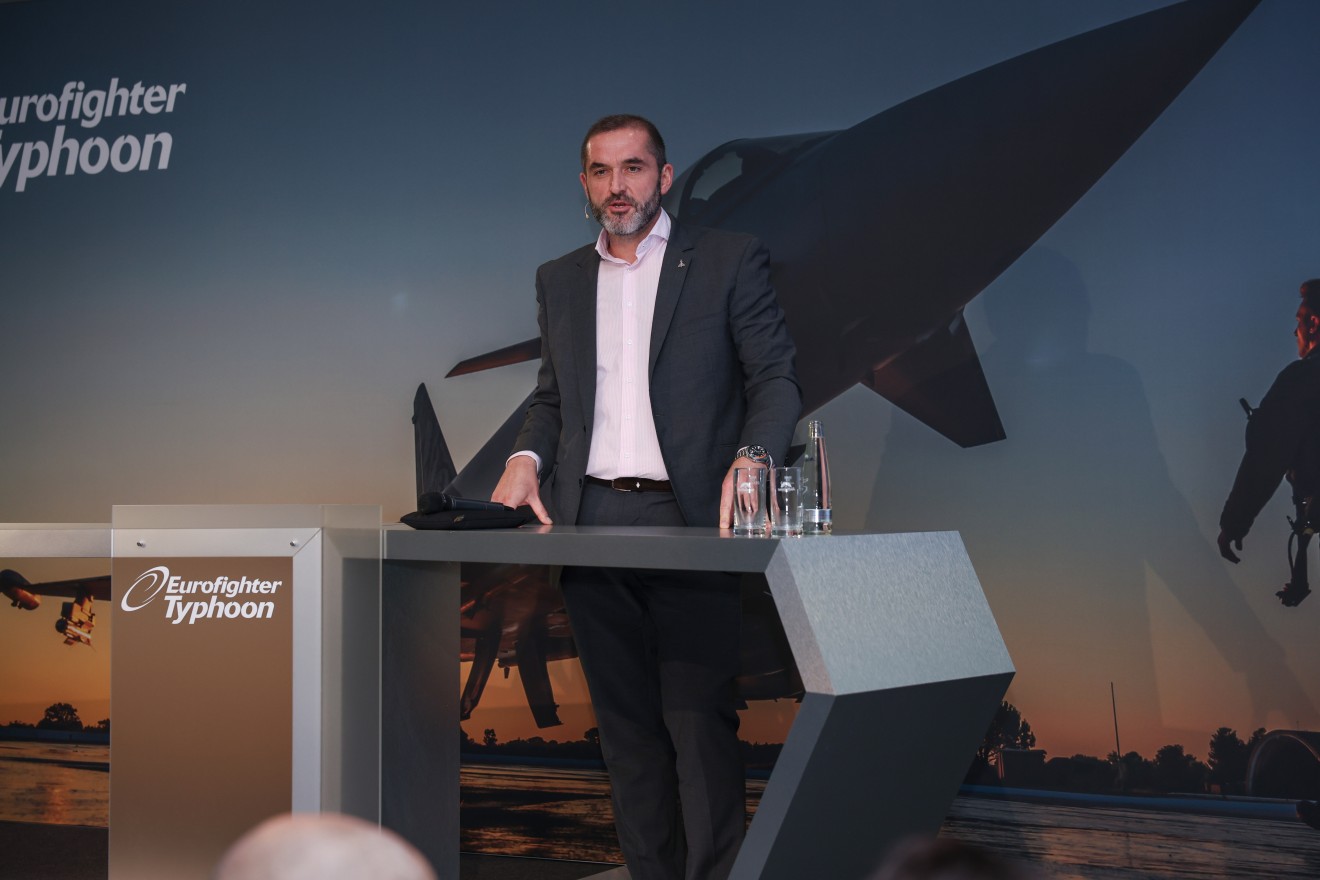
As Eurofighter closes in on the landmark achievement of one million flying hours, CEO Jorge Tamarit-Degenhardt reflects on a transformational year for the programme.
From new international orders and production ramp-up to Eurofighter’s growing role in European defence sovereignty. In this exclusive interview, he shares insights on what’s been achieved so far and why the next chapter will define the future of European air power.
Six months ago, you outlined ambitious priorities for Eurofighter — accelerating production, regaining supply chain control, and capturing future opportunities. Are you making progress?
Absolutely! We‘re making significant progress — and doing it fast. You may recall I was very insistent that speed matters in today’s environment, so I’m pleased we’re climbing at this rate.
We announced that we were accelerating the production rate to 20 jets per year, and even eyeing 30, as we would be expecting additional orders kicking in. Six months on, we have secured large orders like Germany’s Tranche 5, with 20 jets, and the optional 8 from last year’s deal with Italy.
Then, of course, came the news that the Turkish Air Force will become the 10th nation to operate the Eurofighter following an agreement between the UK Government and the Republic of Türkiye for 20 aircraft and an associated weapons and integration package.
This milestone strengthens Europe’s defence capabilities and reflects the fact that the Typhoon is not only a world-class weapon system but also a powerful diplomatic platform. It shows it is bringing nations together, strengthening alliances, and fostering long-term cooperation across Europe and beyond.
That’s quite a list. More than a hundred Typhoons to deliver!
We are really living a step change, one that proves that the Eurofighter Typhoon is not a legacy platform. It’s far more than a weapon system, it’s a tool of diplomacy and an instrument of foreign policy.
I honestly expect these latest orders will be followed by more, especially exports, as well as the full execution of the weapon system Mid Life Upgrade we knew as LTE (Long Term Evolution).
This obviously represents a challenge, as we are ramping up production in an environment where we are competing against other programmes which are doing the same, often with much larger volumes, especially in the commercial arena.
When, on top of that, you add the inherent demands of obsolescence, natural in a programme in its midlife, and the desperate need for a more streamlined airworthiness process, then yes, the challenge is huge. But it’s equally rewarding, fun, beautiful and historic.
That is why, over the past six months, we have also made tangible progress by launching a Eurofighter enterprise-wide transformation project. It is not just another fancy initiative; this time, the world is signalling it is a NO-FAIL mission. These additional orders — for jets that will be operating and supported into the 2060s, and evolving faster than emerging threats — make one thing clear: we cannot afford to fail. We must put everything into making Eurofighter faster, smarter, and stronger.
Eurofighter is about to reach one million flying hours — a remarkable achievement. What does this milestone represent to you and to the whole Eurofighter enterprise?
It’s a truly historic milestone that reflects three decades of teamwork, innovation, and commitment from thousands of people across Europe.
One million flying hours is not just a number; it’s a testament to the aircraft’s enduring performance, adaptability, and relevance in an evolving global security environment. It symbolises the trust placed in Eurofighter by our partner nations and export customers, and the outstanding professionalism of the pilots, engineers, and maintainers who operate and support it every day.
For everyone involved in the programme — past and present — it’s a moment of pride and a reminder that Eurofighter is not only a symbol of European technological excellence, but also of long-term international collaboration.
Over these one million hours, air forces worldwide have trusted Eurofighter with QRA duties, complex exercises, and operational missions. What does this level of international confidence say about the platform’s reliability and maturity?
We can proudly say that around 80% of Core Nations' operational air missions are executed by the Eurofighter Typhoon. That demonstrates its exceptional mission reliability.
Be it for air policing missions, joint patrol initiatives, combat missions or Quick Reaction Alert, the Typhoon represents the air combat mass for Europe. If we think about its operational presence in the Middle East, we can reach the same conclusions.
The million flight hours milestone says everything. Eurofighter is, without question, one of the most reliable and combat-proven aircraft in the world. One that has consistently delivered Air Power to the Air Forces operating it, since its introduction.
That level of confidence doesn’t happen by chance — it’s built through experience, continuous improvement, and the robustness of the industrial and support network behind it. Today, Eurofighter stands as a cornerstone of NATO and allied air defence, fully interoperable and adaptable to a wide range of mission requirements. It’s a platform you can trust, every hour of every day.
How is Eurofighter contributing to the Readiness 2030 initiative to rearm Europe, and what role are you playing in European defence sovereignty discussions?
When we talk about defence, there are three fundamental concepts at play: deterrence, sovereignty and socio-economic return.
Starting with deterrence capacity, the Eurofighter Typhoon executes 80% of the air combat missions in Europe. It provides credible, rapid-response air power that underpins both national and collective defence. But, beyond its operational performance, it also strengthens deterrence through its technological, industrial and political dimension.
It represents a shared European capability, sustained by a cooperative supply chain and technological base that reinforces strategic autonomy and alliance cohesion. To put it in one word, sovereignty.
And, if we reflect on the socio-economic impact, we know the Eurofighter Typhoon sustains more than 100,000 jobs across more than 400 suppliers in Europe. That’s massive, isn’t it?
Therefore, Eurofighter plays a critical role in strengthening Europe’s defence readiness and sovereignty. Through the Readiness 2030 initiative we’re working closely with our partner nations to ensure their fleets are mission-ready, equipped with the latest capabilities, and supported by a resilient European industrial base.
Beyond readiness, Eurofighter is a living example of European defence cooperation in action — an operational, scalable, and upgradeable platform that keeps skills, technologies, and decision-making within Europe.
We’re also an active participant in discussions shaping the future of European air power and sovereignty. Our experience managing a four-nation programme gives us unique insight into what works. We know how to harmonise requirements, share investment, and deliver operational advantage collectively. That experience will be invaluable as Europe develops the next generation of combat air systems.
As we celebrate one milestone, what’s your vision for the next million hours of Eurofighter?
The next million hours will be about evolution — keeping Eurofighter at the heart of combat air capability, while bridging next-generation combat systems.
Our focus is multi-faceted. First, we must ensure operational readiness of the combat mass of Europe and the Middle East. At the same time, we aim to ensure the platform remains future-ready — integrating next-generation sensors, weapons, connectivity, and electronic warfare systems to guarantee air dominance well into the 2060s.
Ultimately, the next million hours will build on the legacy of the first — combining proven performance with future potential. Eurofighter’s story is far from complete; in many ways, it’s just entering its most exciting chapter.