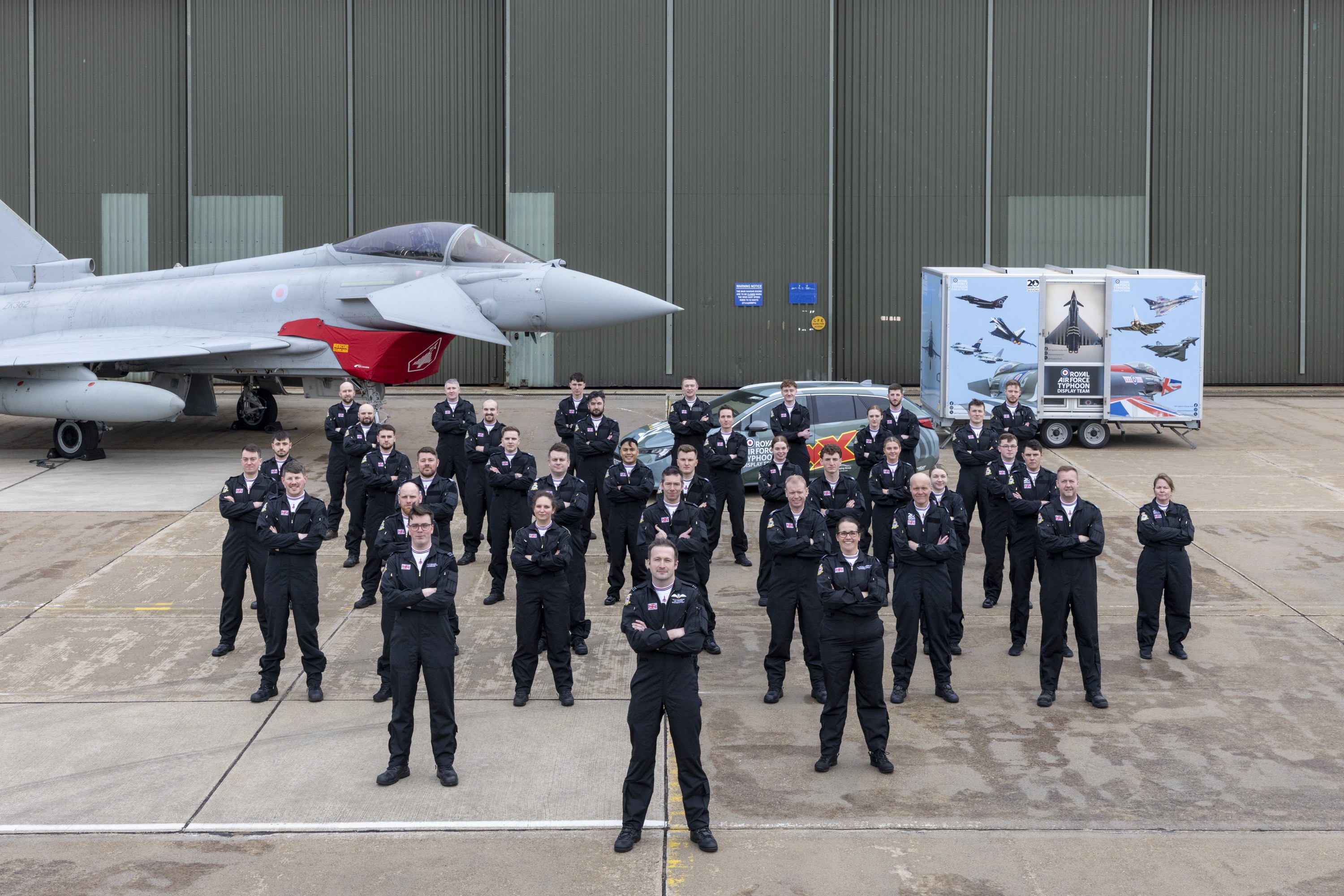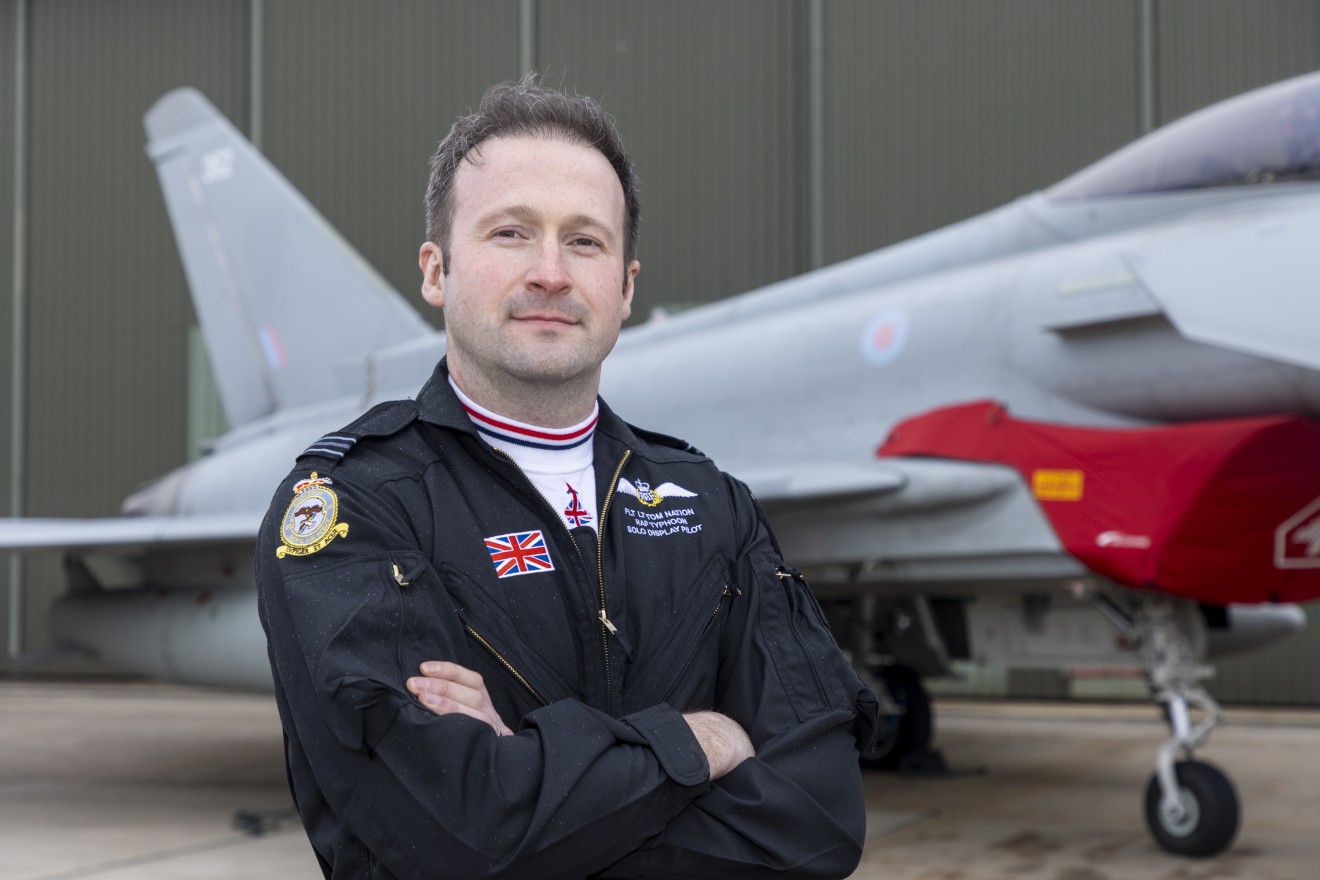
Tom Nation's path to the cockpit began at home. His father was a commercial pilot. His mother held a private pilot's licence. He was just two when he attended his first airshow.
"I don't have an imagination," he says with a grin. "I just went, I'll do that, please. And it kind of stuck from there."
Growing up in Pontypridd, South Wales, Nation spent most summers at airshows, watching fast jets perform overhead and deciding, quietly and with absolute certainty, that he wanted to fly them. He joined 1004 Squadron Air Cadets at 13, learned to fly with 634 Volunteer Gliding Squadron, and became a gliding instructor at 16. By the time he arrived at Swansea University to study Aerospace Engineering, and later Materials Science, the direction of travel was already set. He joined the Royal Air Force in 2015.
Dream into reality
The fast jet training pipeline is thorough. Nation completed his Initial Officer Training at RAF Cranwell, then Elementary Flying Training on the Grob Tutor at RAF Wittering with 16 Squadron. Streamed fast jet, he moved to RAF Linton-on-Ouse for Basic Fast Jet Training on the Tucano T1.
"Linton was probably one of the best years of my life," he says. "It was just amazing fun."
A period on 1 Air Experience Flight at MOD St Athan followed, where Nation flew cadets on experience flights in the Tutor. He recognises the symmetry now. "That's how I came through the system. And there I was inspiring the next generation. Some of the most fun flying I have done, actually. You get a 13-year-old that has never been in an aeroplane before and suddenly you’re flying them upside down. It was pretty awesome."
Advanced Flying Training and the Tactics and Weapons course on the Hawk T2 at RAF Valley, with 25 Squadron and 4 Squadron respectively, followed. Nation describes Valley as where the hard work really begins. He emerged from it and arrived at 29 Squadron in early 2021 to begin his Typhoon operational conversion.
Flying solo on Typhoon
The first Typhoon flight is a rite of passage with a particular twist. The Eurofighter Typhoon's Operational Conversion Unit flies students solo from the outset.
"You take off and you have a moment where you think: I have never actually landed this aeroplane. And now I have got to come back in and land it."
His parents had driven to RAF Coningsby to watch from the car park. Nation was too in the zone to spot them. "I was pretty focused on not crashing!" he laughs.
You take off and you have a moment where you think: I have never actually landed this aeroplane. And now I have got to come back in and land it."
He recalls going on a practice diversion to Newcastle Airport, then flew some aerobatics, before returning to do circuits. "I remember getting out and thinking: I have just flown a grey jet. When you look in the mirrors and you see this pretty big aircraft behind you, and then you plug the burner in and get a proper kick in the pants... it was a pretty special moment."
Nation was initially posted to 6 Squadron, at RAF Lossiemouth. The operational record that followed is substantial: two tours on Operation Shader, NATO air policing in Eastern Europe, a deployment to the Falkland Islands, and Exercise Pitch Black 22 in Australia, which marked the Eurofighter Typhoon's first visit to that country.
The long trail to Pitch Black produced some memorable flying of its own. "Landing into Delhi International as a four-ship in really bad weather," Nation recalls. "We were not an airliner, trying to fit in amongst what was a pretty busy amount of civil traffic. Eye-opening. But so much fun."
He was also part of the 70-aircraft formation that flew over London for the Platinum Jubilee in 2022. "It was a pretty big moment. The Queen's final Jubilee. It was a nice moment to be part of."
Posted back to 29 Squadron at RAF Coningsby as an instructor in September 2024, Nation was selected as the 2026 RAF Typhoon Display Pilot and shadowed his predecessor, Squadron Leader Nathan Shawyer, throughout the 2025 season.
Nine minutes at 9G
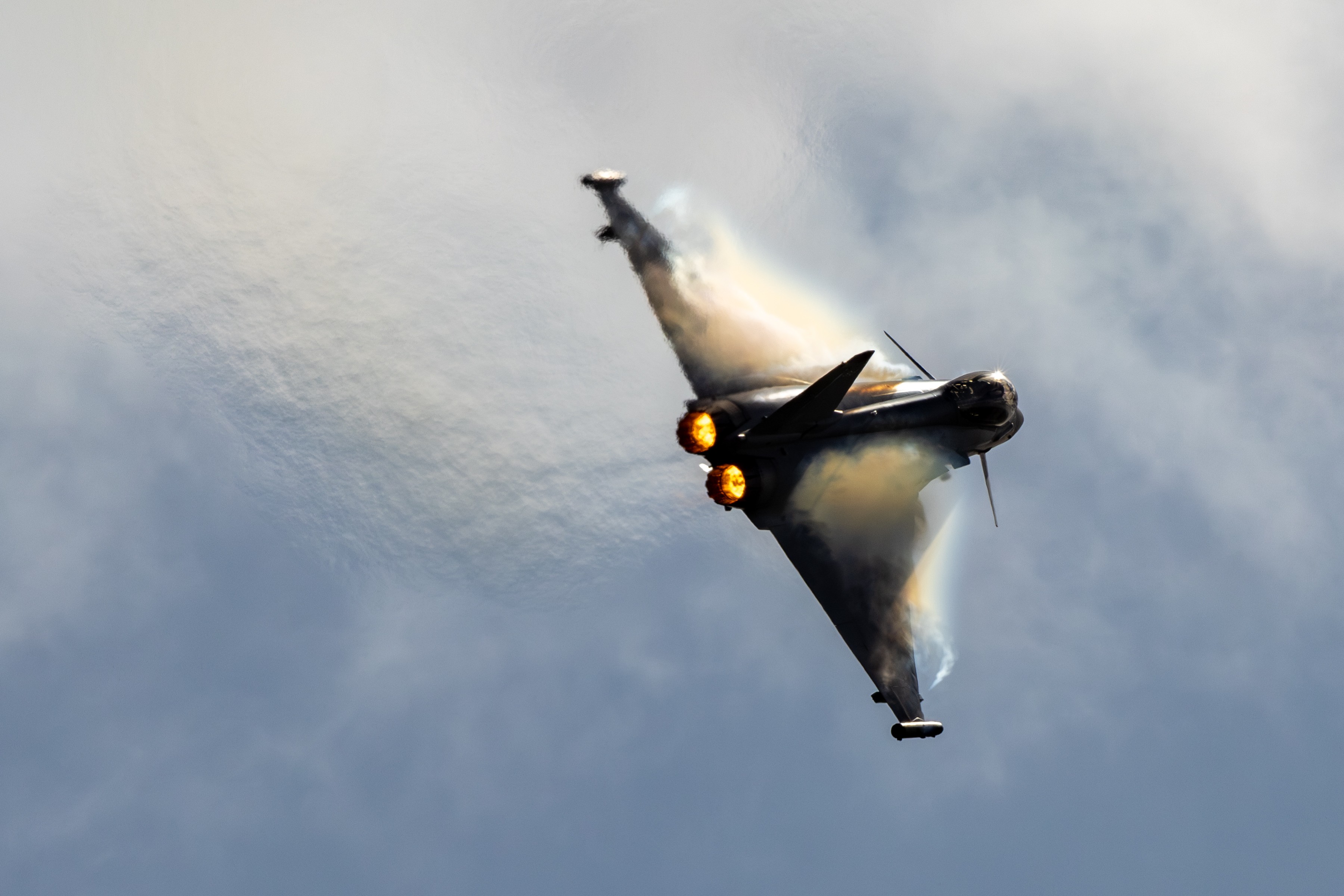
He’s been working on the display for months now, but when you boil it down it comes down to this: nine minutes covering a G envelope of minus 3 to plus 9, with multiple manoeuvres sustaining maximum G for 20 to 30 seconds at a time. Nation lands drenched in sweat.
"It is like doing a heavy weight session, with sprints thrown in for good measure."
The preparation starts before he even reaches the cockpit. "I take myself away and I armchair fly it. I close my eyes and go through what I am going to do from start to finish."
Once airborne and displaying, the focus is absolute. "Your mental capacity to enjoy it as such is not really there. You are too focused to think, this is fun. If you have a moment where you think, this is fun, you are probably messing something up, because you are close to the ground, going fast, and there is very little margin for error."
I can load it into a 9G barrel roll and go straight into a max-rate 9G turn at 500 knots. You could not do that in most other aeroplanes. They would have bled all their energy
The physical demands prompted a visit to the gym. "It is demanding, there is no doubt about it. I wear extra compression sleeves on my arms because my arms really hurt when I am flying it."
Nation is matter-of-fact about what makes the Eurofighter Typhoon such a capable display aircraft. The EJ200 engines, he explains, mean that anyone within four or five miles knows when he moves the throttle forward.
The jet's ability to sustain energy under high G allows him to keep the display tight to the crowd line throughout. "I can load it into a 9G barrel roll and go straight into a max-rate 9G turn at 500 knots. You could not do that in most other aeroplanes. They would have bled all their energy."
Get ready for the Reuben Roll
Display sequence design begins during the preceding season. Nation spent 2025 watching the display from the ground, making notes, building an idea of what he wanted to try.
"You go to airshows and think, that looks cool, I would not mind trying a bit of that. And you kind of have an idea of what will look good."
The sequence then moves to the simulator: ten sorties to check the flow and feel, before transitioning to the aircraft at 5,000 feet and working progressively down to display height.
The closing manoeuvre of this year's sequence is a nod to the late Mark Long's 2016 display. "A vertical departure with three twinkle rolls. That was a fair amount of influence."
There is also a manoeuvre Nation calls the Reuben Roll. His stepson Reuben, who is six years old, watched footage of display flying and pointed at one particular sequence. He thought it looked cool. The manoeuvre, an aileron roll into a hesitation roll into a second aileron roll, is now part of the 2026 sequence.
"It’s actually quite hard to fly so I thank him for that! Hopefully people will think it is cool, Reuben certainly does," Nation laughs.
Coming full circle
Nation is looking forward to displaying in Wales in front of what he calls his home crowd. He is also looking forward to RIAT. He attended the Royal International Air Tattoo many times as a child, watching from the crowd line.
"Being on the other side of it is a pretty big buzz. It still has not really sunk in, to be honest."
He is aware of what the display might mean to a child standing in the crowd this summer, looking up. Someone like him, 25 years ago, face turned to the sky.
"It feels like it is coming full circle. There might be some kids out there who will see a jet and think, jets are pretty cool, and then go and do a degree in engineering or something like that. That is the main reason. That is what this is for."