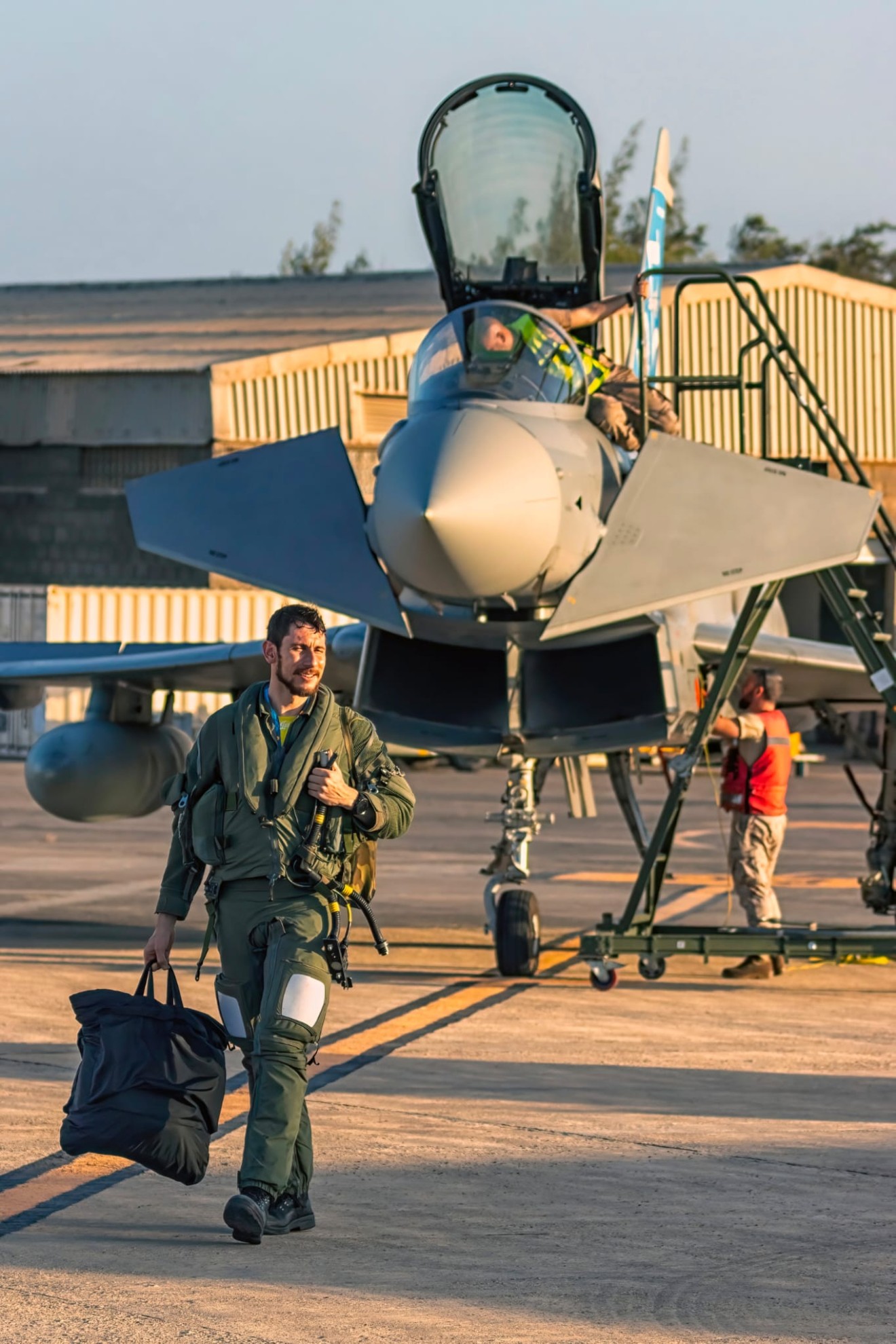
Routine? “Definitely not. Our training flights must be demanding enough to keep our performance above the expected standards, and we need to optimise every minute in the air. There is no time for routine.”
What may appear straightforward from the outside carries its own intensity in the cockpit.
“On ferry or positioning flights, I consider what I am doing to be something outstanding, not achievable by just anyone. The views, the clouds, the seat vibrations, the feeling of the stick and the sensations related to the flight make every moment unforgettable.”
That heightened awareness is constant because circumstances can change without warning. Captain Casado recalls an evening sortie over the Mediterranean Sea while returning to base after a training mission, when the tasking shifted unexpectedly.
“I remember we were coming back when suddenly we were tasked with identifying an unknown aircraft flying at medium level. It was evening, and the sunlight was turning red in the west.”
Within moments, a standard recovery became an operational intercept. “We received the tracks via Link 16 and within seconds had them on our radar. We proceeded to intercept. As we approached, our FLIR image revealed seven aircraft flying in close formation.”
The situation quickly clarified. “It was the Patrulla Aguila returning home from an airshow in France. We escorted them back to San Javier air base.”
For Captain Casado, experiences like this reinforce a simple principle. No flight can be taken lightly.
Experience has taught me that there is no such thing as a low intensity flight. The key is to consider all possible variables and prepare a response for the most probable situations. You must always think ahead.
Becoming operational on Eurofighter requires a shift in perspective. The platform fundamentally changes how a pilot manages information and makes decisions.
“The most important change is understanding the level of situational awareness Eurofighter provides about the tactical scenario developing around you in real time. Compared to other aircraft, you learn to focus on the mission and the best course of action, rather than gathering that awareness yourself while also fighting to control the aircraft.”
Designed for active life
The design of Eurofighter supports that evolution. He says: “Eurofighter makes it easy to maintain flight energy, and combined with the sensor fusion capabilities, it becomes much easier to understand what is happening around you. You can concentrate on decision making instead of simply managing the aircraft.”
Sustaining performance over time, including during QRA rotations, comes back to repetition and rigour.
“Training is what allows you to keep up to date with new tactics, techniques and procedures. Eurofighter enables highly realistic combat simulation even in training environments.”
For new pilots entering the cockpit, the adjustment is immediate and demanding. “The engine power and thrust, the high manoeuvrability and G performance, and the amount of information available in the cockpit can make it challenging at first to focus your attention in the right place at the right time.”
You must remain disciplined. Never underestimate Eurofighter or the mission
His advice reflects the mindset behind every one of those million flying hours. “You must remain disciplined. Never underestimate Eurofighter or the mission.”
One million flying hours is not built on routine. It is built on vigilance, preparation and the professionalism of pilots who approach every sortie with intent.